

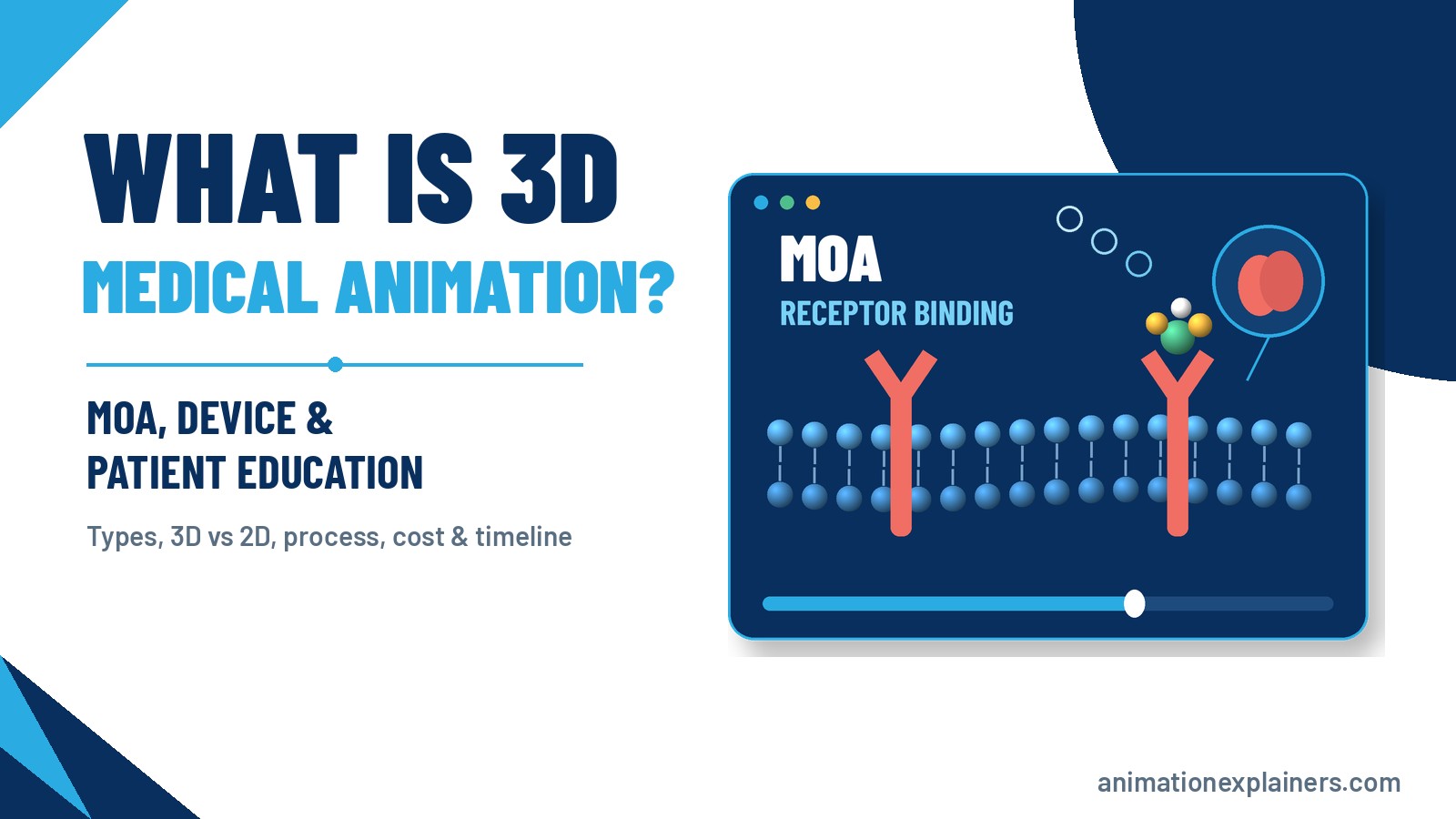
What Is 3D Medical Animation? MOA, Device & Patient Education Explained
3D medical animation is computer-generated animation that shows the inside of the body, a medical device or a biological process in three dimensions, so viewers can see what a camera can't. It is used to explain how a medicine works (mechanism of action), how a device works and is used, and what a condition or treatment means for patients. Pharma, biotech, medtech and healthcare teams use it for clinician education, patient education, training, sales and congresses.
If you have been asked for “a 3D medical animation” or “an MOA video”, this guide explains in plain words what that involves: the main types, how mechanism of action, device and patient education films differ, when 2D is the better choice, how a film is made and reviewed, and what it costs.
3D medical animation is one specialised use of the wider craft. For the basics of modelling, lighting and rendering, start with our guide to what 3D animation is.
What is 3D medical animation?
3D medical animation builds anatomy, devices, cells and molecules as digital 3D models, then moves a virtual camera through them in time with a voiceover. Because everything is built rather than filmed, the film can show any scale, any angle and any layer of the body.
A camera in an operating theatre records whatever happens to be in the way. A 3D model can remove the skin, make an organ transparent, slow a heartbeat or zoom from a whole organ to a single receptor. The viewer sees exactly the part that matters, in the order the voiceover explains it.
Most 3D medical animation is built from the same set of building blocks:
- Anatomy models: organs, vessels, bones, muscles and nerves, shown whole, in cross-section or with layers peeled away.
- Device models: an implant, catheter, inhaler or instrument, often built from the manufacturer’s own CAD files so it matches the real product.
- Cells and molecules: membranes, receptors, antibodies, enzymes and drug molecules, at a scale no microscope can film in motion.
- Camera moves: a continuous journey from the outside of the body to the target, so the viewer never loses their place.
- Lighting, colour and transparency that pick out the structure being discussed and fade back everything else.
- Labels, on-screen text and voiceover that name each structure as it appears and carry the explanation.
“3D medical animation”, “medical animation 3D” and “3D animation medical” all mean the same thing. “Medical animation” on its own is wider: it also covers 2D and motion graphics films about health.
Types of 3D medical animation
Most 3D medical animation falls into a handful of types. The type depends on what the audience needs to understand, not on the software used to make it.
| Type | What it shows | Typical audience |
| Mechanism of action (MOA) | How a medicine acts in the body, from organ down to cell or molecule | Healthcare professionals, medical affairs, investors |
| Mechanism of disease (MOD) | What goes wrong in a disease before treatment | Clinicians, disease-awareness campaigns, patients |
| Medical device animation | How a device is built, how it works and how it sits or acts in the body | Surgeons, clinicians, buyers, distributors |
| Procedure and surgical technique | The steps of a procedure, with the anatomy cleared so each step is visible | Surgeons, clinical trainers, sales teams |
| Patient education | What a condition is, what the treatment does and what to expect | Patients, caregivers, trial participants |
| Training and instructions for use | How to prepare, use, clean or troubleshoot a device or therapy | Nurses, technicians, patients at home |
| Cell and molecular science | A platform technology, pathway or research finding | Scientists, partners, investors |
| Congress and sales films | A short, high-finish version of the core story | Booth visitors, sales meetings, launches |
Many projects combine two or three of these: one master film, such as an MOA or device film, plus shorter cut-downs built from the same models.
Mechanism of action (MOA) animation explained
A mechanism of action animation shows how a medicine works in the body, step by step. It usually starts at the level of the organ and zooms down to the cell or molecule where the drug acts.
MOA is the clearest case of something that can’t be filmed at all. A typical MOA film has four beats:
- Set up the disease. Show what is going wrong: an overactive pathway, a missing enzyme, a receptor that is switched on when it shouldn’t be. This part is often called the mechanism of disease (MOD).
- Show the target. Zoom to the cell, receptor or protein the medicine is designed to act on, and name it.
- Show what the medicine does. The drug molecule binds, blocks, replaces or switches something, and the film shows the knock-on effect inside the cell.
- Show what it means. Pull back out to the tissue or the patient so the viewer connects the molecular event to the clinical picture.
The science and every claim in an MOA film come from the client’s approved sources, and the film goes through their medical, legal and regulatory review before release. The animation team’s job is to show that science clearly, not to add to it.
Cybin’s film is a good example of science explained at molecule level, though it is a 2D company explainer rather than a regulated MOA film. Filmed lab and therapy-room scenes alternate with flat animated molecules: hydrogen atoms swapped for deuterium, a compound in the same family as serotonin, and the brain receptors it connects to.
For mechanism films for medicines and biotech, see our pharmaceutical animation page.
3D medical device animation
3D medical device animation shows how a device is built, how it works and what it does inside or on the body. It is often the only way to show a device at work where no camera can go.
A device film has to answer three questions: what is it, how is it used, and what does it do in the body. 3D helps with all three:
- Inside the body. The device can be shown in place, in an artery, a joint or a nasal passage, with the surrounding tissue made transparent.
- Inside the device. Housings can open, parts can separate in an exploded view, and a mechanism can be slowed down.
- Step by step. Each stage of placement or use can be shown from the clearest angle, then repeated from another.
- Before it exists. A device that is still in development can be shown from CAD files, which helps with investors, partners and early sales conversations.
Highpoint’s film is a clear example of a device shown in 3D inside the body. It opens on the patient’s problem, chronic rhinitis, then cuts to a 3D cross-section of the nasal cavity, where a slim probe positions an electrode tip against the tissue. An on-screen note tells viewers that the activation shown is indicative only, which is exactly the kind of care a device film needs.
Our medical device animation page covers how we approach device films. For product-only renders and launch spots, see 3D product animation.
Patient education and training animation
Patient education animation explains a condition, a treatment or a procedure in plain words, so patients and caregivers know what to expect. Training animation does the same for staff, showing how to prepare, use or care for a device or therapy.
The same medical subject needs a different film for a patient than for a specialist. For a lay audience:
- Lead with the person, not the molecule. Start with what the patient feels or will experience, then explain what is happening inside.
- Use less detail, not less accuracy. A simplified heart is fine; a wrong heart is not.
- Keep the tone calm. Clean visuals, gentle pacing and a warm voice matter more than a dramatic render.
- Say what happens next. End with the practical step: what to ask, what to bring, when to call.
- Plan for captions and languages so the film works on a waiting-room screen with the sound off and for every patient group.
OcuDyne’s film is written for patients who might take part in a clinical study. In 2D, it explains the eye condition, why the study team thinks a narrowed artery may matter, what the investigational procedure involves and what the evaluations look like, then asks viewers to talk to their doctor.
For learning films more broadly, see our educational explainer videos guide and our educational video production page. Staff and device training films are covered on our training videos page.
3D vs 2D medical animation
3D suits subjects where shape, depth and movement are the point: anatomy, devices, surgical steps and molecules. 2D medical animation suits patient stories, disease awareness, services and instructions, where warmth and clarity matter more than realism.
| 3D medical animation | 2D medical animation | |
| Best for | Anatomy, devices, procedures, molecular mechanisms | Patient education, awareness, services, digital health, instructions |
| Typical audience | Clinicians, scientists, surgeons, buyers | Patients, caregivers, staff, the public |
| What it shows well | Real shape, depth and the inside of things | People, emotions, metaphors and simple diagrams |
| Look | Realistic or stylised renders | Flat illustration, characters, motion graphics |
| Changes late in the project | Slower: models, lighting and renders may need redoing | Usually quicker: a frame or a label can be changed |
| Cost | Sits higher in the budget | Usually lower for the same length |
| Hybrid option | 3D mechanism or device inside a 2D story | 2D story that cuts to a 3D close-up |
2D is not a compromise: a metaphor can explain a process faster than a realistic render, especially for patients. Endeavor BioMedicines’ film shows this. It explains how cells copy their DNA, using two characters, the immune system and a quality-control inspector, who check each new cell as it comes off a copying machine. When the copier makes a mistake, the film shows how a mutation can lead to cancer cells, then explains how a genetic test on a tissue or blood sample looks for it.
Many medical films are hybrids: a short 2D or motion graphics story sets up the patient’s problem, then cuts to 3D for the device or the mechanism. For people-led medical stories, see our 2D explainer videos page; for how the two styles compare outside medicine, see our comparison of 2D vs 3D animation.
How a 3D medical animation is made
A 3D medical animation goes through the same stages as any animated explainer, with more research and review built in. Each stage is approved before the next starts, so changes are made while they are still cheap.
- Brief and sources. We agree what the film must achieve, who it is for and where it will play, and you share the approved sources: references, product information, claims that have been signed off, and CAD files for any device.
- Script. A short voiceover script, usually about 150 to 225 words for 60 to 90 seconds, written from your sources around one clear message. Your medical reviewer checks every claim at this stage.
- Storyboard. Rough frames show each shot, including where the camera moves from organ to cell, what is labelled and what is made transparent.
- Style frames and models. The anatomy, device and molecule models are built, and a few finished stills set the look: realism, colour, lighting and labels, matched to your brand.
- Voiceover and music. A professional voice records the approved script, with careful pronunciation of drug names and anatomy, and music is chosen to match the pace.
- Animation and rendering. Every shot is animated to the voiceover, lit, rendered and finished with sound, captions and on-screen text.
- Final review and delivery. Your reviewers check the finished film, and we deliver the master plus any cut-downs, languages or caption versions agreed at the start.
Accuracy, sources and medical review
Accuracy comes from process, not from the render:
- Your sources lead. Every statement and every visual should trace back to a reference or approved document you have supplied.
- Detail is a decision. We agree early how literal each structure needs to be. A molecule can be stylised; a device that a surgeon will use should match the real product.
- Your reviewers sign off. Medical, legal and regulatory review (often called MLR) happens on your side, usually at script, storyboard and final film. We build those checkpoints into the schedule.
- On-screen notes where needed. If a sequence is simplified or illustrative, the film can say so, as Highpoint’s does.
Most of the clarity in a medical film is decided at script and storyboard stage. Our explainer video production process covers each stage in more detail.
3D medical animation cost and timeline
The price of a 3D medical animation depends mainly on its length, how much custom modelling it needs, how detailed the anatomy or molecules are and how many versions you need. At Animation Explainers, projects typically range from $6,000-$35,000+, and detailed 3D medical work usually sits in the upper part of that band.
| What it means for a 3D medical animation | |
| Price range at Animation Explainers | $6,000-$35,000+ |
| Typical timeline (60 to 90 seconds) | About 4-6 weeks from kick-off to final delivery |
| What raises the cost | Longer films, custom anatomy or device models, molecular detail, photoreal rendering, extra languages and cut-downs |
| What keeps it down | One clear message, CAD files or existing models, stylised rather than photoreal visuals, a 2D story with 3D only where it matters |
| What adds time | Extra review rounds on your side, late changes to approved claims, new models after storyboard approval |
| Revisions | Three rounds, one per stage: script, storyboard and animation |
| Who owns the video | You do |
A typical 60 to 90 second animated explainer takes about 4-6 weeks. Detailed 3D work and your review process can add time, so we set the schedule at kick-off. Every project includes three rounds of revisions, one per stage, and you own the rights to the finished video. Our explainer video cost guide explains in more detail what moves the price.
Where 3D medical animation is used
3D medical animation is used wherever a team has to explain something inside the body, inside a device or too small to see. This is how it tends to fit the sectors and therapy areas we hear about most:
| Industry or area | How 3D medical animation usually helps |
| Pharma and biotech | Mechanism of action and disease films for clinicians, medical affairs and investors |
| Medical devices and medtech | How a device works, how it is placed and what it does in the body |
| Surgery and orthopaedics | Procedure steps with the anatomy cleared, for training and sales |
| Cardiology and vascular | Heart, vessels and catheter-based devices shown from inside |
| Oncology | Tumour biology, targets and how a therapy acts, for clinicians and patients |
| Diagnostics and lab science | What a test detects and how a sample is processed |
| Ophthalmology, ENT and dental | Small, complex anatomy shown clearly at any scale |
| Hospitals, health systems and charities | Patient education, procedure preparation and awareness campaigns |
For the full range of health films, including 2D and motion graphics work for digital health and services, see our medical animation videos page. When the film is about a physical product outside medicine, our 3D animation production page covers modelled product films.
When 3D isn't the best choice. If the story depends on emotion, behaviour or trust, such as a care service, a digital health app or a sensitive diagnosis, 2D characters usually connect better and cost less. If the subject is a set of numbers or a pathway of care, motion graphics may explain it faster. Use 3D where the viewer needs to see a real structure.
How to brief a 3D medical animation
A clear brief is the quickest way to an accurate, on-time medical film. Work through these steps before you talk to anyone.
- Name the one message. Write the single sentence you want the viewer to remember, such as how the medicine works or why the device is different.
- Describe the audience. Specialists, general clinicians, buyers, patients or the public each need a different level of detail and a different tone.
- Say where it will play. A congress booth, a sales tablet, a patient website and a training portal each need a different length and pace.
- Gather your sources. References, approved claims, product information and any existing medical illustrations save research time.
- Send your models. CAD files for a device, or existing 3D assets, make modelling faster and the result more faithful.
- Map your review. Tell us who signs off and at which stages, so medical, legal and regulatory review is in the schedule from day one.
- Agree the call to action. Decide what the viewer should do at the end, such as speak to a representative, ask their doctor or visit a page.
With that brief, an explainer video company can tell you quickly whether 3D, 2D or a hybrid will explain your subject best, and what it will take. We make medical films for pharma, biotech, medtech and healthcare teams. Get in touch with a line about what you need to explain and who it’s for, and we will suggest an approach and show you style frames before anything is animated.
FAQ
What is 3D medical animation in simple terms?
It is animation built from 3D models of the body, devices, cells and molecules. A virtual camera moves through those models in time with a voiceover to explain how a medicine, device, condition or procedure works.
What is the difference between medical animation and 3D medical animation?
3D medical animation is one type of medical animation. Medical animation covers any animated film about health, including 2D character films and motion graphics. 3D medical animation uses modelled anatomy, devices and molecules to show depth, scale and the inside of things.
What is a mechanism of action (MOA) animation?
An MOA animation shows how a medicine works in the body, step by step. It usually zooms from the organ down to the cell or molecule where the drug acts, then pulls back out to show what that means for the patient.
What is the difference between MOA and MOD animation?
MOA shows what the medicine does; MOD (mechanism of disease) shows what goes wrong in the disease before treatment. Many films include both, with the disease first so the mechanism that follows has something to act on.
What is medical device animation used for?
It shows how a device is built, how it works, how it is used and what it does inside or on the body. Teams use it for surgeon and clinician training, sales and distributor conversations, congresses, investor updates and instructions for use.
Is 3D or 2D better for medical animation?
It depends on what the audience needs to see. 3D suits anatomy, devices, procedures and molecules where shape and movement matter. 2D suits patient education, awareness and services, where warmth and clarity matter more. Many films combine the two.
Can 3D medical animation be used for patient education?
Yes, with less detail and a calmer tone than a clinical film. Patient films lead with what the person will experience, use simplified but accurate anatomy, and end with a clear next step. 2D is often a good fit for patients, with 3D for the moments that need it.
How accurate is 3D medical animation?
As accurate as its sources and review. The script and visuals should come from the client’s approved references, the level of detail is agreed early, and the client’s medical, legal and regulatory reviewers sign off before release. Simplified sequences can carry an on-screen note.
What does a medical animator do?
A medical animator turns medical and scientific information into clear visuals. The work covers researching the subject, modelling anatomy, devices or molecules, animating and lighting each shot, and working with scriptwriters and the client’s reviewers so the film is accurate.
What software is used for 3D medical animation?
Professional 3D modelling, animation and rendering software, plus compositing and editing tools. The software matters less than the script, the storyboard and the medical accuracy behind them.
Can you make a 3D medical animation for free?
Free 3D tools exist, but a medical film needs research, accurate models, a professional voiceover and review. That takes skilled time, so most teams commission one.
How much does 3D medical animation cost?
At Animation Explainers, projects typically range from $6,000-$35,000+. Detailed 3D medical work usually sits in the upper part of that band. Length, custom modelling, level of detail, languages and versions move the price.
How long does it take to make a 3D medical animation?
A typical 60 to 90 second animated explainer takes about 4-6 weeks. Detailed 3D and your own review process can add time, so the schedule is set at kick-off, working back from any launch or congress date.
Who owns the video, and how many revisions are included?
You own the rights to the finished video. Every project includes three rounds of revisions, one per stage: script, storyboard and animation.

What is 3D medical animation in simple terms?
It is animation built from 3D models of the body, devices, cells and molecules. A virtual camera moves through those models in time with a voiceover to explain how a medicine, device, condition or procedure works.
What is the difference between medical animation and 3D medical animation?
3D medical animation is one type of medical animation. Medical animation covers any animated film about health, including 2D character films and motion graphics. 3D medical animation uses modelled anatomy, devices and molecules to show depth, scale and the inside of things.
What is a mechanism of action (MOA) animation?
An MOA animation shows how a medicine works in the body, step by step. It usually zooms from the organ down to the cell or molecule where the drug acts, then pulls back out to show what that means for the patient.
What is the difference between MOA and MOD animation?
MOA shows what the medicine does; MOD (mechanism of disease) shows what goes wrong in the disease before treatment. Many films include both, with the disease first so the mechanism that follows has something to act on.
What is medical device animation used for?
It shows how a device is built, how it works, how it is used and what it does inside or on the body. Teams use it for surgeon and clinician training, sales and distributor conversations, congresses, investor updates and instructions for use.
Is 3D or 2D better for medical animation?
It depends on what the audience needs to see. 3D suits anatomy, devices, procedures and molecules where shape and movement matter. 2D suits patient education, awareness and services, where warmth and clarity matter more. Many films combine the two.
Can 3D medical animation be used for patient education?
Yes, with less detail and a calmer tone than a clinical film. Patient films lead with what the person will experience, use simplified but accurate anatomy, and end with a clear next step. 2D is often a good fit for patients, with 3D for the moments that need it.
How accurate is 3D medical animation?
As accurate as its sources and review. The script and visuals should come from the client’s approved references, the level of detail is agreed early, and the client’s medical, legal and regulatory reviewers sign off before release. Simplified sequences can carry an on-screen note.
What does a medical animator do?
A medical animator turns medical and scientific information into clear visuals. The work covers researching the subject, modelling anatomy, devices or molecules, animating and lighting each shot, and working with scriptwriters and the client’s reviewers so the film is accurate.
What software is used for 3D medical animation?
Professional 3D modelling, animation and rendering software, plus compositing and editing tools. The software matters less than the script, the storyboard and the medical accuracy behind them.
Can you make a 3D medical animation for free?
Free 3D tools exist, but a medical film needs research, accurate models, a professional voiceover and review. That takes skilled time, so most teams commission one.
How much does 3D medical animation cost?
At Animation Explainers, projects typically range from $6,000-$35,000+. Detailed 3D medical work usually sits in the upper part of that band. Length, custom modelling, level of detail, languages and versions move the price.
How long does it take to make a 3D medical animation?
A typical 60 to 90 second animated explainer takes about 4-6 weeks. Detailed 3D and your own review process can add time, so the schedule is set at kick-off, working back from any launch or congress date.
Who owns the video, and how many revisions are included?
You own the rights to the finished video. Every project includes three rounds of revisions, one per stage: script, storyboard and animation.